Heads up, this content is 18 years old. Please keep its age in mind while reading.
The following article will appear in Riseup.net‘s upcoming educational publication about safety and security in online organizing. You get to have the sneak peak here.
Blogging with Split Personalities:
How I Created and Reconciled My Separate Spaces On the Web
by Sarah Dopp
Hi, my name is Sarah, and I’m a compulsive blogger. It all started in high school when I created a website under a pseudonym and used it to tell stories about my love life. It was a thrilling and introspective project that resulted in a lot of great writing. Unfortunately, though, I was so terrified someone would connect it to me that I never saved a backup copy. That website has since expired, and those words are now lost forever in the murky underbelly of the Internet. First lesson learned: If I’m not going to claim something, I can’t hold onto it.
Read the rest of this entry »
 Posted in Adventures, My Projects, my story, The Creative Life, Writing |
  Comments Off on Blogging With Split Personalities | May 13th, 2008
Heads up, this content is 18 years old. Please keep its age in mind while reading.
There’s a lot of buzz right know around something called the social graph. This buzz is very geeky, and if you’re not already immersed in geeky conversations about Internet privacy and identity, this buzz might be going over your head. That’s a shame, though, because you probably do care about it.
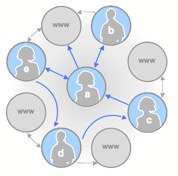 What’s a Social Graph?
You have lots of contacts. Some are professional colleagues, some are personal friends, some are both of those, and some are more complicated than that. A social graph is a snapshot of who you’re connected to and how. The specifics are super-geeky, so I’m not gonna go any deeper than that.
What’s Happening Now?
Google just released something called the Social Graph API. This is going to make it easier for social networking websites to share information about who you’re connected to. This opens up a huge can of worms in terms of privacy and identity and security and all that fun stuff that the Internet’s been debating since it was born.
How Does This Affect You?
At the moment, it doesn’t. It’s too new. But it’s pushing the borders on what we need to think about when we use social networking websites, and that’s going to matter to you as soon as it gets to your favorite websites. Looking ahead to the not-so-distant future, you should probably prepare yourself for two things:
1) You’re going to have an easier time sharing your “friends list” between your social networking websites without having to give out your email address book. This also means that signing up for a new social networking website won’t be such a headache.
2) You’re going to have a harder time compartmentalizing and obscuring different parts of your life on the Internet. There will still be a place for pseudonym-based anonymity, but with all of these networks talking to each other, it’s going to be harder to hide. So if you’ve got skeletons in your public MySpace closet and you’ve just figured that nobody’s gonna look behind that door, you might wanna go clear those out now.
Posted in social media | 6 Comments » | February 3rd, 2008
Heads up, this content is 19 years old. Please keep its age in mind while reading.
I got a ride home from the Internet Identity Workshop (IIW) from a VP at a Fortune 500 company, and we talked about the complicated natures of our love lives. It felt a little bit like driving home after summer camp, especially since I was on Day 2 with my jeans and underwear. Fortunately, though, I was sporting a nice clean IIW schwag t-shirt, which was neatly ironed for me by the astrophysicist who let me crash on his fold-out hotel suite couch the night before. This, of course, happened after I sang and danced to Abba’s “Dancing Queen” with the conference organizer during karaoke.
The last session I attended at IIW was called “Newbies4Newbies.” Five of us conference first-timers sat around a table with one of the community’s longtime members and talked about our experience. We were all pretty much on the same page with observations:
- The sparse conference website and jargon-heavy materials provided beforehand gave us the impression that this was a self-contained community. We felt like we were crashing someone else’s party.
- We ended up in some conversations that were way over our heads, and felt a moment of panic that were very, very much in the wrong place.
- We took some initiative to figure out what was going on, and started to notice how passionate and productive this community was.
- We began to feel like we were being heartily welcomed by everyone we talked to, and saw people going out of their way to make sure we were able to engaged in the conversations.
- We connected with great thinkers and leaders who made themselves available for our questions and ideas, and who took the time to explain complex ideas to us in language we could understand.
- People recognized that we, as newcomers, had a valuable perspective to offer on what they were doing, and they asked us to share it.
- We felt like we had become an integral part of the community, and we were sad to see the conference end.
“Workshop” is a fitting term for the event. It really was about getting stuff done. Before I realized what was happening, I found myself helping to spearhead two new working groups which now have clear missions for ongoing roles in the community. The first is called Inclusive Initiatives, and its plan is to coordinate events and identify research studies that will help bring to light a wide range of perspectives on what the public needs from identity solutions. Somehow, I became the Stewards Council Representative for this group (go figure).
The second group sprung out of the “Newbies4Newbies” conversation. We’re rallying together to help bridge the gap between this brilliant community and the people who could join it but don’t know how. Our hope is that by making the website more accessible, developing clear introduction materials, and identifying people who can serve as mentors within the community, Identity Commons will broaden its reach, its influence, and its pool of resources for being effective.
This community is pulling the Internet into an arena where our information is safe and manageable by us, the users. Its projects include things that will take our passwords out of the hands of people we don’t trust, and take our consumer experiences out of the hands of marketers. It’s “the good fight” for our rights on the web.
Listen to me. I’m on a soapbox already. These people got under my skin.
tag: iiw2007b, iiw
Posted in Community, conferences, Philosophy | 13 Comments » | December 6th, 2007