Heads up, this content is 19 years old. Please keep its age in mind while reading.

Once upon a time, there was a social networking website called Friendster.

friendster-logo.gif

Friendster had a good thing going for awhile, being the only decent social networking website on the Internet and all. But then Friendster made a few mistakes, and people stopped using it. Even though Friendster is still out there today, most people consider it dead.

dead-friendster.gif

Then another social networking website came along called Facebook.

facebook-logo.gif

Facebook had a good thing going for awhile, too. Since Friendster had already paved the way for social networking, there was already a broad user base to draw from, and LOTS of people joined Facebook. (Facebook made some pretty big mistakes, too, but we’re not going to get into that right now.)

Facebook and Friendster had a lot in common. They both let people post information about themselves. One of those information pieces was “relationship status.” You know, like single, in a relationship, married, etc. Friendster went a step further than the standard categories and added a category called “it’s complicated.”

Facebook decided this was a good idea, and they did the same thing. After all, many relationships are complicated, and it’s important to let people express themselves in a way that fits.

facebook-complicated.gif

Then Dead-Friendster yelled out, No! No! We said that first! It’s ours! And they added a trademark symbol to it, to claim their territory.

friendster-complicated2.gif

And then the Internet laughed and ignored Dead-Friendster, because even though Dead-Friendster wanted to be important again, you just can’t trademark a complication.

And because the Internet is a cruel, cruel place, the Internet decided to give the trademark (in spirit) to Facebook. Just to spit in Dead-Friendster’s eye.
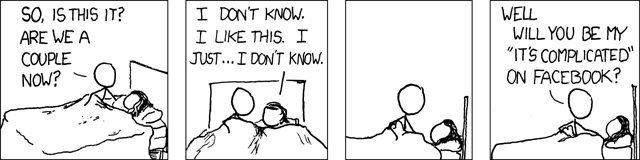
And they all lived complicatedly ever after.

The End!

Heads up, this content is 19 years old. Please keep its age in mind while reading.

I love Tara Hunt’s post today about Social Capital and Community Freeloaders. She dives into the nature of “favors from friends,” and writes:

“Now, I don’t want to reduce every interaction we human beings have with another person to being a transaction, but, in effect, it is. If I ask a friend for a favor, she is bound oblige. However, if I ask that same friend for ten favors, she may start to feel like I’ve depleted my “allowance” on my account with her. Of course, with different people, we have more leeway. With our close friends and family we have loads of Social Capital to withdraw from and as our relationships get more casual, the less influence and favor we carry with others.”

Basically, you have a bank account. The more Social Capital you’ve accumulated in that bank account, the more of a safety net you have when things get rough and you need help.

Tara breaks Social Capital transactions into a very nice table of deposits and withdrawals. “Performing a favor,” for example, is a deposit. ” Expecting that people come to your events when you don’t go to theirs,” on the other hand, is a clear example of a withdrawal.

I appreciate that she lists all of these deposits:

  • Asking for the first favor
  • Asking for a lateral introduction
  • Encouraging people to get involved in your projects.
  • Requesting simple advice.

It’s the second favor, the prestigious introductions, the unsolicited sales pitches, and the extensive advice that send hits to your Social Capital resources. But simple and friendly “I could use your help” shoulder-taps can actually strengthen a connection. They show someone that they’re important to you, and that you value what they have to offer.

Another fun read on this subject is Never Eat Alone: And Other Secrets to Success, One Relationship at a Time.

Heads up, this content is 19 years old. Please keep its age in mind while reading.

I’m thankful that I can still pull out my New Hampshire plaid shirt and rock the farmer-girl look when green beans and sweet potatoes are hitting the table.

I’m thankful that two years ago, I spent my first Thanksgiving in San Francisco roaming the streets alone, seeing the holiday from a completely different perspective. I’m equally thankful that this year, I’ve had more turkey dinner invitations than I could say “yes” to. Much to my surprise, I’m attending four of them (one of which is being described online in mouth-watering detail). I’m thankful that this means I’ve made friends in this city, many of whom I’ve started calling “family.”

I’m thankful that my family of origin is healthy and safe and doing well. My mother, a minister, doesn’t have to work today. Neither does my step-father, a business owner. All five of their children are off in different cities sharing thanksgiving meals without them, and they are home, quiet, feeling immensely thankful to be home for once, and to be able to be quiet.

I lost a grandfather this year –a big man of few words who always carved the Thanksgiving turkey when I was growing up. I remember his large, calloused carpenter hands. They built things for us. They carried us. They were rocks.

I still have five living grandparents. Five. I have a lot to be thankful for. And somewhere in New Hampshire, there is an 8-year-old girl who thinks her Cousin Sarah is the most exciting person in the whole entire world, and I take that responsibility very seriously.

I’m thankful that I found the tech industry (or maybe that the tech industry found me). I spend every day in awe that there is a community and an economy that values all of my skills, embraces my independent style, and pays me well enough to live in this (expensive) beautiful fairytale land of a city. I accepted a position at a new firm yesterday. My gratitude and excitement are uncontainable.

And I’m thankful I didn’t wake up this morning with a Surfer Dude next to me. And I’m hopeful that if he figures out how to spell my last name and decides to google me, he’ll forgive me for my recounted perspective on our evening.

Please remember the pilgrims today, and vow to be much more sincere and respectful than our country’s origins teach us to be.

Cheers!