Archive for the ‘Philosophy’ category
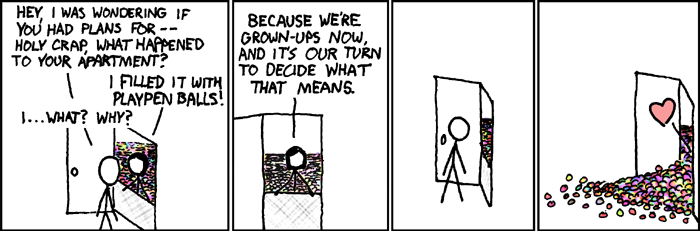
Inspired by a recent email by Melissa Gira about doing something “for the story of it,” I present you with… my decision-making flowchart:
It’s here — the holiday of all holidays — Geek New Year. The intersection of the end of SXSW Interactive and St. Patrick’s Day, when everyone who made the annual pilgrimage to Austin, TX is wandering home, rubbing their eyes and thinking a thousand new thoughts about how the coming year will be. And drinking.
I skipped SXSW this year, and didn’t miss it much. But apparently, 2009 Me took some steps to keep 2010 Me in the loop just so I wouldn’t feel left out. I woke up this morning to an email I’d sent myself a year ago using FutureMe.org. The subject line read, “listenupmotherfucker.” (And I’m such a nice person to everyone else…)
If you’ve watched me twitter on New Years, you know I make a grandiose attempt to discourage everyone in the world from making resolutions. Resolutions are often about picking something really hard that you feel guilty about, and throwing yourself at it drunkenly with all your might, only to fail in about a month. What does that really do, besides pull a few muscles and prove your incompetence? We need better traditions.
Mine is writing a letter to myself a year in the future. I include reminders, predictions, ideas, requests, and stories I want to carry forward. It’s me having an ongoing, ritualized conversation between the past, the present, and the future, and I love it. I love watching my own story unfold in a correspondence with myself over time.
Except last year I fucked it up.
Last year I forgot to write myself a letter on New Years, and it bugged me for months. So on March 17th, St. Patrick’s Day and the end of SXSWi, after two weeks of traveling, I decided that despite being too wrecked to move, I could see the whole timeline of my life Very Clearly and had a LOT to say about it.
Here’s the letter I received this morning (with a few light revisions to make it more bloggable):
From: Sarah Dopp
To: Sarah Dopp
Date: March 17, 2010
Subj: From me to me, listenupmotherfucker.Dear FutureMe,
It’s the last night of SXSW and I’m a fucking zombie. I’ve been traveling for two weeks — first a week in Portland and now this. Roomed with Melissa, Boffery’s a madman of vision, and Genderfork is exploding with passion. I want my Dopp Juice voice back. Queer Open Mic is getting its sea legs again, and occasionally I think about book deals and self-publishing. I’m speaking soon on gender and sexuality ambiguities, and in general, my life’s pretty fucking cool.
So why am I so stoned on exhaustion that I can’t even pack my fucking suitcase?
Okay, listen up. I skipped the letter from New Years so this one’s a few months late. Here’s the deal. You’re reading this in 2010, right? Shut up and keep talking. That’s my brilliant plan. Just do that, and you’ll be fine.
No, seriously, though. Here’s what you need to know:
1) Stop calling yourself an entrepreneur. It’s bullshit.
2) Don’t go back to school, even if you know you can. It’s bullshit, and you have better ways to spend your time.
3) If you forget the different between following your heart and doing what seems right, go read XKCD’s Fuck That Shit again.
4) If you get stuck, go read the Cult of Done Manifesto again.
5) Genderfork Book. Build the community. Meetups, volunteers, whatever.
6) Go talk to [redacted] about representing a community that you don’t see yourself as a complete representative of.
7) You can do this. You have to. You don’t know how not to.
Stay alive. I love you.
Sarah
p.s. I really like The Squeeze right now.
I must have been very tired, because I have absolutely no recollection of writing this.
I’m particularly fond of the line, “Shut up and keep talking. That’s my brilliant plan. Just do that, and you’ll be fine.”
And aside from that… yeah… this is how I talk to myself.
Go write your letter now. It’s a new New Year.
A year ago, I wrote an open letter to Silicon Valley, asking people to stop and think about how they’re handling gender (and race, for that matter) in their community websites. The short version is that if you’re requiring users to select their gender from a drop-down menu that has two options in it, you’re alienating some people. I didn’t offer alternative solutions at the time — it was just a request for everyone to think about it.
(Note: if you’re not clear on why gender is a complicated issue in data collection, please stop right now and go read that other post before continuing. This will make a lot more sense after you do so.)
After grappling with this problem on a few other projects, and talking about it in a session last week at She’s Geeky (I called it “My gender broke your drop-down menu…”), I’d like to now offer my suggested alternatives.
Alternatives to asking for a user’s gender in a required two-option drop-down menu…
Option 1: Make it Optional
Baby steps. If the idea of getting fancy with your data collection method gives you nightmares, just remove the red asterisk. Stop making it required! Most people will still answer the question, and those who don’t want to will select not to. Put a plan in place for how to treat and account for those who don’t want to declare their genders, and you’re done. It’s not the most celebratory or inclusive measure, but it is a very clean way to resolve a lot of problems.
Option 2: Don’t Ask At All
Instead of asking for gender, ask for what you actually want to know.
Is it what honorific should precede the person’s name? Well, then gender’s not going to tell you if they’re a doctor or a reverend, is it? Give them a comprehensive list of options, and allow them to select none, if they wish. (And really, why do we use these again? My preference is to drop them entirely.)
Is it what marketing you think they’ll respond best to? Newsflash: not every woman likes baking, and not every man likes cars. Ask them about their interests and market to them on that basis, instead.
Is gender not actually relevant at all, except that you think it makes for an interesting statistic? Meh. I’d like to convince you that you really shouldn’t touch it, but if I’m not going to win that argument, please see Option 1.
Option 3: Have a Third Option
Your drop-down menus can have more than two options. Some people are trying three.
I’ve spent a lot of time thinking about this, and here’s my current position:
- “Other” is a poor choice for a third option. Why? Because gender-nonconforming people are othered enough as it is.
- A more useful choice would be “Decline to State” (or something similar) — then it’s not about non-conformity, it’s about privacy.
- But taking this a bit further, I’d like to submit “It’s Complicated” for consideration as the new third option. Most gender-nonconforming types will smile at you for it. It tells them you understand.
I’ve seen some people try to implement a “lots of options” dropdown menu, but I don’t really recommend this route, for two reasons:
- What if someone looks at the list and doesn’t identify with any of the words? You just alienated them much further than your male/female dropdown menu was doing before.
- What if someone identifies as more than one thing on the list? Take, for example, a transsexual woman who is proud to identify as a woman. Are you really going to make her choose between “trans” and “woman”? Come on now. That’s insulting.
If you change it from a drop-down menu (“pick only one”) to a checkbox menu (“select all that apply”), you solve issue #2, but you still have issue #1 to grapple with. And let me tell you: if you think you can come up with a finite list of all the possible gender identities in the world, you’re wrong.
Option 4: Redesign the System
So you’re convinced that “male/female” is a deeply flawed data breakdown for the purpose of your website, but you want people to assert their identities, and you want them to get personal about it. Okay, then! Time to scrap the dropdowns and do something new. Here are some ideas…
A “gender spectrum” slider bar. Take a look at how Blackbox Republic is structuring their sexual identity data:
I could see a similar thing done with “masculine” and “feminine” at each end, and letting people self-identify.
Note: one huge problem with the spectrum model is that it’s too flat. I believe there are people who have “a lot of gender” (i.e. dripping both masculinity and femininity all over the place) and “not a lot of gender” (i.e. minimizing signals of any gender whatsoever), and on the spectrum, they might look the same. But that brings up my next idea, which is…
A second dropdown that asks how important gender is to them. Take a look at how OkCupid handles religion. You get one dropdown menu for how you identify, and a second dropdown menu for how important it is to you. For some people, their gender is a strongly identifying factor in their lives. For others, it’s nearly irrelevant. What if we just started asking that question?
You could also…
Get fancy and use Kreative Korp’s SGOSelect menu (or some variation on it), which basically says: if you have a traditional identity, you can use the simple form. And if you want to get more specific, you can switch over to the Advanced form:
… but it still runs into the “finite number of options” problem, even in the Advanced view.
And that brings me to my last suggestion, which so far seems to be my holy grail. I worked this out with my co-founder team at Boffery while we were strategizing the user interface… with some outside input from Kirrily Robert of Freebase:
An open-ended tagging field that suggests words as you type. I want to be able to define my gender as “female, androgynous, genderqueer.” And I believe that if we were all encouraged to, we would come up with a great rich vocabulary that uniquely characterizes ourselves in all the ways a two-option gender set is trying to do, but failing at. If the tagging system were set up to automatically suggest words as you typed, you could either loop in to what others are saying and be associated with that group, or create your own words and add them to the lexicon. The result would be a rich mix of groupable/categorizable labels (marketers: this is far more meaningful than what you’re currently working with), along with the ability for us to self-identify however we want.
I don’t have a picture for you ‘cuz it hasn’t been built yet. But if anyone understands what I’m talking about and wants to test it out, let me know.
I want in.
Love,
Sarah
ETA: immediately after I posted this, a designer took a stab at the open-ended tagging field idea and sent me early concept mockups. Check ‘em out!
Over dinner last Thursday night, maymay and I spent several hours discussing what makes a Good Web Development Team, based on our particular work styles. Here’s what we came up with (refined from a crude notebook sketch):

Particular things to note here…
- All team members have direct access to one another, and are encouraged to work together in real-time. Quality assurance, scope agreements, user experience development, and engineering development all depend on direct collaboration.
- D@n has already pointed out that we left out Sys Admin. That’s a good point, and it should probably be its own person, with direct lines to Front-End, Back-End, and Project Manager.
- He also expressed concern about QA not being a specific person. I stand by the current model for dev teams that don’t aspire to grow any bigger than the setup above — peer-checking is sufficient. As maymay put it, “QA is a state of mind.” It’s always happening, and it can be structured to happen systematically.
- Job roles and personal skills don’t always perfectly align. In my case, I can play both Front-End Developer and Project Manager, each with a particular flavor. And maymay can take on both Front-End and Back-End Developer roles if the expectations are right. But for both of us, it seems the case that if we only have to take on one role per project, we’re able to do better work.
This is just an abstract exercise in theoretical structuring based on our experience — not meant as anything to be set in stone. Take it for what you will, and feel free to expand on it.
Enjoy!,
Sarah
I’ve been quietly rolling an interesting comparison around in my head for a few months now, and lately it’s been dribbling out onto my work and my conversations. I take this to mean it’s probably time to blog about it, and to ask you to help me dissect it. Wanna have a go at it? Here’s my theory:
Social media consultants are a lot like therapists. Or at least, they should be. Or they are if they’re doing their jobs well.
Or, put differently: when someone is looking for a social media consultant, what they really need is a social media therapist.
Here’s what I’m looking at so far…
1) Since having a social media presence is about reputation and relationships, it needs to be personal to the individual. A consultant can’t just prescribe an approach and walk away. The approach needs to be custom-tailored to fit the client’s personality and worldview, and the client needs to have a lot of say in the development of this fit. Thus, one of the consultant’s biggest jobs is to ask the right questions, shut up and listen, and let the client find their own answers.
2) Having an effective social media presence is different from traditional marketing, and it’s also different from the ways we’ve been using the internet in the past. So clients need to adjust to a new way of approaching things, and this adjustment takes time. One of the most effective things a social media consultant can do is be available for regular, hour-long, therapy-like sessions in which the client talks about what they’re experiencing (feelings and all), and the consultant helps them separate out the useful thinking from the off-base stuff…. over and over again, until the client gets it.
3) Developing a social media presence has to be done gradually. A client has to pay attention to what’s working and what’s not, listen to feedback from the community, and constantly refine their approach with little changes. If a consultant plans on being around for regular sessions, the client has a regular schedule for examining the feedback they’re receiving and incrementally improving their approach.
4) The social media consulting model is in contrast to the web development consulting model, where you just build something and walk away until it needs to be updated. It’s also in contrast to the idea that social media consultants exist to give expert advice — if clients think of them that way, they’ll only go to them with the big questions, and try to answer the little questions on their own. But social media success is in the details, and it’s the little questions that will make or break an online presence.
Working conclusion: Get over yourselves, consultants. You’re therapists. Deal with it. And do it right.
I’ll be speaking at Mountain Social, a gathering in the mountains of Georgia next fall where we’ll be discussing better uses of internet technologies (you should come!), and I’ve already proposed this as a topic I want to dig into further while I’m there. So I figure that gives me 5 months to figure out just how deep this rabbit hole goes.
What does it bring up for you?
I want to believe in micropayments.
It’s like Santa Claus, the tooth fairy, the economic stimulus package, predefined timelines for large projects, nonfat lattes, and God. I want to believe in micropayments because it gives me hope…
I’m talking about hope that we’re on the right track. Hope that we have a viable, sustainable alternate plan for the business models we’re turning upside down with our new technology. Hope that we can decentralize power without losing it altogether. Hope that we can survive without the monopolies. Hope that artists will be able make a living just by inspiring people. Hope that the average Internet user will soon derive as much satisfaction from giving financial props to someone they find valuable as they’d get from buying them a beer.
I naively believed we were close to this reality because someone — iTunes — is actually finally doing it well. I believed the biggest barrier was form of payment: if you have to enter your credit card number or go to a separate payment website or do anything that takes more than a click or a few keystrokes, the method won’t catch on. iTunes broke that barrier for iPhone users when they required us to sign up for an iTunes account (and enter our credit card number in advance) just to download those nifty free apps. We didn’t like entering our credit card number, but it was Apple, so we knew everything was gonna be okay. Now that we’ve done it, whenever we get a song stuck in our heads at 3 AM and decide we need to listen to it right then, all we have to do is enter a password and it’s ours for 99 cents. A password. Just a password! Anywhere we are. It’s brilliant.
It was so easy to take it a step further: if Apple can do it, other industries can’t be too far behind. Heck, we could even let Apple become the new PayPal and run all of our micropayments throught them, since they already have our trust. Why not? Let independent artists have their own merchant accounts. Expand the system to cover writers, filmmakers, painters, and photographers. Let high school kids make 50 cents each time one of the cool screen savers they create is downloaded. Let me pay for shareware incrementally based on the number of times I use it. Let me donate to a nonprofit in small chunks whenever they inspire or move me. Empower the bloggers to fund each other. Make it easy for us to put our money where our hearts are.
I was this close to swallowing the whole story of technological utopia when Clay Shirky — in his infinite clarity — shot it down this morning.
“The essential thing to understand about small payments is that users don’t like being nickel-and-dimed. We have the phrase ‘nickel-and-dimed’ because this dislike is both general and strong.”
So… people don’t like micropayments. Oh. Right. (And… now that I think about it, yeah okay, I kinda hate them, too.)
And…
“The lesson of iTunes et al (indeed, the only real lesson of small payment systems generally) is that if you want something that doesn’t survive contact with the market, you can’t let it have contact with the market. …small payments survive in the absence of a market for other legal options.”
So… iTunes is an aberration that only works because the music industry is kinda screwed up at the moment.
He ends with:
“We should be talking about new models for employing reporters rather than resuscitating old models for employing publishers; the longer we waste fantasizing about magic solutions for the latter problem, the less time we have to figure out real solutions to the former one.”
But Clay! I wasn’t talking about employing publishers! I want the micropayments to go directly to the reporters!
But okay… fine… you win. It won’t work for that, either.
So what’s our Plan B?
Dear Silicon Valley,
First of all, I don’t know if I’ve told you this lately, but I love you. We do great things here, and this life is pretty damned fun. You’ve taken very good care of me, introduced me to brilliant people, given me the tools to stay connected with a world of friends, and even started paying my rent. I’m forever grateful that we found each other.
And I have a favor to ask.
I’m noticing that the stuff we make here — these websites and tools and communities — can influence the rest of the world pretty significantly. It used to be that only the geeks were using the Internet, but now it’s becoming “pretty much everybody.” And here’s the powerful thing: when a website is considered “good,” whatever that website displays as content, images, default settings, or options is considered “normal” by its users. You have the power to influence “normal.” I could give you examples, but I know you already know what I’m talking about.
The favor I want to ask is this: please think about how you’re handling race and gender on your websites. Just look at it. You don’t have to change anything. Just make a mental note in your head about what your saying to your users about the importance of race and gender, and the categories that exist for them.
I’ll give you a hint: If you’re still asking about race in a required drop-down menu, you’re way behind. Because doing it that way says to a user:
- You have a race.
- It’s really important to me.
- It’s one (and only one) of these listed here.
Seriously, I really don’t think you’re doing this, because it would be horribly weird. My friend with the half-Jamaican-half-Chinese father and Irish immigrant mother would either laugh hysterically at you or be extraordinarily offended. “You want me to tell you what? WHY??”
The way we build a profile page matters. You get that it matters.
So… this next part’s gonna sound a little weird, but hear me out for a minute. I think gender is taking the same path as race. It’s still visually defining, but people are starting to acknowledge that there are grey areas. And those grey areas are growing.
There’s a longstanding argument that “male” and “female” are a biologically-defined and relevant way to split our population in half. But if you’ve ever met a feminine man or a masculine woman, you know that these categories are way too rough to mean anything more than a stereotype sometimes.
It goes deeper than that. For example, within lesbian communities, “butch” and “femme” have been considered separate genders for awhile now. Yes, they’re both female (well, sometimes), but they have different roles both in the community and in relationships (except when they don’t, which is true for any gender). There’s also a growing presence of people who are living today as a different gender than the one they were assigned at birth. Sometimes you notice them and sometimes you don’t. (Hint: You won’t know how many you aren’t noticing — that’s the point.) There are people born intersex — with the biological features of more than one gender (and there are more of these than you might expect). And you may have noticed this in cities and among young people — there’s also a growing presence of folks whose genders you just can’t identify. Some of them, if you ask them respectfully, will tell you they feel like both genders. Or neither gender. Or a gender that needs a new name. They might answer to both “he” and “she,” or they might prefer something different. They’re in-between, and that’s where they belong.
Just for a minute, try to imagine yourself in the shoes of someone who has spent a lifetime feeling just as uncomfortable in the men’s locker room as in the women’s locker room — for whatever reason. Imagine having to dress in clothing that just feels wrong to you, everyday, because you know it means you’ll be treated better than you would if you wore what you like. Imagine walking through the world knowing that everyone’s first assumptions about how you see yourself, who you love, and what feels right for you are completely wrong.
Now imagine signing up for a cool website, and then being required to select an option from a drop-down menu that doesn’t include anything that represents you. If you don’t decide to close the browser window right then and there, you’ll probably pick the gender of the restroom you still use in public when you have no other choice (even though people might stop you to tell you you’re in the wrong one no matter what), and you’ll feel defeated. You’ll want to argue that whatever they think they’re learning from that drop-down menu, it’s not really true. You’ll want to tell them that they’re adding to your humiliation by making you do this. You’ll want to tell them that they’re missing a huge part of you by boiling this rich and beautiful characteristic down into a two-option drop-down menu.
Okay, you can come back now. That’s all I needed from you — just to think about it. The truth is, there are no perfect solutions to this problem right now. Gender is still relevant (except when it’s not) and drop-downs are still the cleanest way to gather data (except when they’re not). To quote Facebook (a site that’s only sort of doing it wrong), “It’s complicated.”
So just keep an eye out. Be aware of what you’re calling normal. Make a mental note of who it might be excluding. Make conscious choices about how you handle things. And please remind the web developer in the next cubicle to do the same.
Thanks and love,
Sarah Dopp
The BlogHer Geek Lab in Washington, DC was loaded with questions about how to improve a blog and increase its reach. I ended up on my soapbox more times than I expected, ranting about misinformation and imploring bloggers to rethink their strategies.
I’m summarizing most of my rants below because I think they’ll be helpful to some people. Please keep in mind that I’m coming at this from my own experience. I’m not an “ad revenue” blogger, and there are plenty out there who can give you tips on what they’ve done to be successful. I encourage you to go talk to them, too.
The Goals Rant
If you ask me, “How can I make my blog better?” I’m going to ask you what “better” means. What are your goals? If you don’t know, stop whatever you’re doing right now and figure them out. Here are some common ones:
I want to…
- express myself in a creative, positive way.
- vent my frustrations in a safe and constructive way.
- work through some challenging issues.
- document a process or experience.
- create a space for myself that’s separate from my daily life.
- establish a certain kind of reputation.
- convey a certain tone and aesthetic.
- serve a certain community in a certain way.
- build a community that supports me.
- make money with ads and affiliate revenue.
- find new work/jobs/clients/customers.
- maintain my existing work/jobs/clients/customers.
- give friends and family a way to keep track of me.
- keep track of my thoughts and the interesting things I’ve found on the web.
If you have a lot of these goals (and hopefully some others I haven’t named yet), that’s great! Now you need to prioritize them. Which ONE do you care about first and foremost? How about second? Third? Fourth? Lay them all out in order — NO TIES! It’s fine if your priorities change in the future, but you need to be honest with yourself about what they are right now.
Once you’ve got that, you’ll know what “better” means. And you’ll probably be able to brainstorm about 20 answers to your original question without any help from me now, too.
The Money Rant
So you want to make money from blogging, and you’ve heard that ad revenue is the way to go. That’s great and I completely support you, but let’s talk about it for a minute.
Thank you all for the positive responses to my story about spending time with the guy I found by the ocean who was having a bad experience on too many drugs.
Even my mother, fortunately, responded with “I’m so proud of you”… which, I think, is a pretty big deal. Most moms I know would be inclined to scream, “WHAT ON EARTH WERE YOU DOING IN THAT DANGEROUS SITUATION?!”
I’ve gotten some responses, though, that put my actions up on some kind of superhuman pedestal, that’s a little weird to me. (I got some of that after the
“homicidal drunk on the airplane” story, too) When people need us (you, me, anyone), we help the way we know how to help, and we don’t think twice about it. There’s nothing magical about that. It’s just showing up.
But people can only respond to what I give them, so it seems misleading at this point not to disclose another piece of my history: I’ve gotten help for substance abuse.
Several years ago, I went through a period where I was severely depressed. I leaned heavily on alcohol to survive it. Pretty quickly, my reliance on alcohol become more destructive than my depression.
There’s a long story here, and I’m going to give you the really short version. I scared myself, I realized I needed help, and I went into an alcohol abuse recovery program (the famous one — the one you’re not supposed to name). I also started seeing a therapist. I spent eight months battling my compulsive actions and the depression that caused them, until I finally got to the root of the problem:
I was queer and not accepting it.
(Ain’t that one a stinker?)
I worked through the depression, and then worked with my therapist to experiment with letting alcohol back into my life. I drank lightly, socially, and didn’t enjoy getting drunk. I wasn’t, by the program’s definition, an alcoholic.
The recovery program and I had a very sad breakup, in which I couldn’t really explain my story because it didn’t fit their model for recovery. I’m still a huge fan of their program, though. I’ve seen it help lots of people — people who sincerely want to be helped — and I think, hands-down, it’s one of the best paths out there. I know it helped me immensely.
But back to why I’m telling you this: the moral of the story is that I’ve spent stretches of time in community with people who are struggling with self-destructive behavior and trying to help each other through it. I learned strategies that allow me to be present for people without letting their pain and flailing get too close to me. And after a few minutes of conversation, I can usually tell the difference between someone who’s really looking for help and someone who’s still trying to control the situation.
This complicated stretch of my life, by the way, is also where I learned that hanging out by the ocean is a good way to remember that I’m not in control, either.
Walking down to the beach last night after dinner, I noticed there was a young athletic-looking guy lying on his back on a platform, shirtless and in basketball shorts, staring at the sky. It looked like a nice place to rest and look up. I walked past him.
Before I got to the water, I heard a loud yell. Like an “AAH!” Then a pause. Then another one. Then I realized it was coming from him. No one else was close enough to notice it or respond.
For a minute, I rolled my eyes and shot an accusatory glance at the ocean. That’s nice, but I have to work tonight. Get someone else, okay?
Two more yells.
Okay, fine.
I walked up to him. “Hey! Are you okay?”
He shook his head like he was trying to talk, and nothing came out. I saw that he was shivering, and took a few steps closer.
“Hey. Do you need me to call an ambulance?
He found my face and said, “No. No. No. Please.”
“Okay. No problem. What do you need? Are you cold? Do you need a blanket?”
“Yes.”
“Okay. I’ll see what I can do. Did you take drugs?”
“Yes.”
“What kind of drugs? Did you take LSD?”
“No.”
My brain ran out of other drug ideas. “What did you take?”
No response. I looked at his scattered stuff. There was a backpack, a textbook, a book called Kama Sutra for Gay Men, a towel, and a jacket wrapped around his leg. He couldn’t move. I climbed onto the platform and wrapped the towel across his chest. I pulled the jacket off his leg, lifted him up by the shoulders, and placed it underneath his back.
I ended up spending four hours with him. The first two were just sitting there, in the cold, trying to get him to talk. He passed out a few times and I shook him back awake. His name was Joey. He was 31. His parents were in Arizona. He hadn’t seen them in a long time and they didn’t accept him. He was gay. He was a massage therapist. He wanted to join the military. He loved to cook. He was addicted to meth, and was in a harm reduction program. He was homeless. He wouldn’t say whether this was a suicide attempt or not. Read the rest of this entry »